book review · Out of Control
Out of Control
2026-04-30 · 3 min read
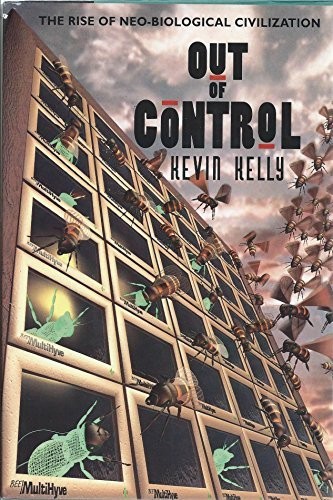
I’ll admit I picked this up specifically for the hive mind chapters, since watching how a colony behaves as one animal is close to my own daily obsession with what a body actually is once you take it apart and put it back together. Kelly delivers there. He walks a beehive from “a bunch of dumb drones” into something closer to a single superintelligent creature distributed across forty thousand bodies, and once that reframing lands you start seeing the same pattern everywhere, crowds, markets, immune systems, the internet before most people were calling it that in 1994.
The book’s actual range is bigger than the hive stuff, biospheres, cybernetics, swarm models, group coherency emerging out of factors too numerous for any one part of the system to track. One quote I keep coming back to, something close to a law he attributes to Kauffman: past a certain point, increasing the richness of connections between agents freezes adaptation entirely, too many actions hinge on too many contradictory other actions, and the whole system locks into what he calls bureaucratic rigor mortis. That’s a genuinely useful way to think about far more than biology, and it’s the kind of idea that’s stuck with me since long after I finished the chapter it came from.
Where the book shows its age, and several other readers have said the same, is that this was cutting-edge thirty years ago and reads that way now, some of the specific technology discussion dated in a way the biology chapters mostly aren’t. Kelly’s a journalist, not a scientist, and it shows in places, generalizations that a specialist reader would flag as trivial even where a casual reader like me found them genuinely illuminating. The chapters are also fairly disconnected from each other, more a series of essays orbiting a theme than a single sustained argument, and I understand the reviewers who gave up partway through for exactly that reason.
I’d recommend this as a starting point rather than a destination, a broad and often lyrical survey of complex-systems thinking that’s more useful for the questions it raises than for any single answer it lands on.